How to Add Lift Transfer, Rotate, and Tandem Modules to Existing Conveyor Systems

Your Conveyor Still Works. Your Process Has Changed.
Many manufacturers invested in pallet conveyor systems years ago because they are reliable, flexible, and built to support long production lifecycles. The conveyor continues to perform as designed, but production requirements rarely stay the same.
New product introductions, increased throughput targets, additional assembly operations, robotic integration, quality inspection requirements, and ergonomic improvements often create the need for additional functionality within an existing line.
The good news is that upgrading capabilities does not always require replacing the entire conveyor system.
In many applications, manufacturers can add lift transfer units, lift-and-rotate stations, tandem conveyor sections, inspection cells, workstations, and product buffers to an existing conveyor layout, allowing them to extend the life and value of their current investment.
Can You Add New Functionality to an Existing Conveyor System?
Yes, in Many Cases You Can.
One of the biggest misconceptions in manufacturing is that conveyor modifications must come exclusively from the original equipment supplier.
In reality, experienced conveyor manufacturers and integrators can often engineer solutions that work alongside existing conveyor infrastructure, helping manufacturers add functionality while minimizing disruption to production.
Common upgrades include:
- Lift Transfer Units (LTUs)
- Lift-and-Rotate Stations
- Tandem Conveyor Systems
- Parallel Conveyor Lines
- Robotic Interface Stations
- Vision Inspection Cells
- Product Buffers
- Manual Assembly Workstations
- Testing Stations
- Product Diverts and Merges
Rather than replacing an entire conveyor line, manufacturers can often enhance specific areas where additional flexibility or capacity is needed.
Common Conveyor Platforms That Are Often Expanded
Many facilities operate conveyor systems that have been running successfully for years and simply need to accommodate new production requirements.
Examples include:
- Bosch Rexroth TS Conveyor Systems
- FlexLink Conveyor Systems
- Dorner Conveyor Systems
- mk North America Conveyor Systems
- Custom Pallet Conveyor Systems
- Legacy Conveyor Installations
Whether the conveyor is ten years old or relatively new, opportunities often exist to add functionality that supports today’s manufacturing needs.
Why Manufacturers Upgrade Existing Conveyor Systems
1. Adding New Assembly Operations
As products evolve, additional assembly steps are often introduced.
Manufacturers may need new operator workstations, testing areas, inspection points, or value-added assembly processes that were not part of the original line design.
Adding a lift transfer, workstation module, or parallel processing lane can often create the required space without redesigning the entire system.
2. Integrating Robotics
Today’s production environments increasingly use collaborative and industrial robots to improve efficiency and consistency.
To effectively present products to robotic systems, manufacturers frequently require:
- Product positioning
- Lift-and-locate functionality
- Product orientation changes
- Pallet transfers
- Dedicated robotic work zones
Lift-and-rotate modules are commonly used to orient products precisely for robotic interaction.
3. Increasing Production Capacity
A conveyor system may have been designed for current demand years ago but now faces higher throughput requirements.
Common challenges include:
- Workstation bottlenecks
- Operator congestion
- Limited assembly space
- Product accumulation issues
Tandem and parallel conveyor systems can create additional processing capacity while utilizing much of the existing infrastructure already in place.
4. Improving Ergonomics and Safety
Many manufacturers seek to improve operator comfort, reduce repetitive motion, and create safer work environments.
Conveyor enhancements can help present products in better working positions while reducing manual handling requirements.
The result is often improved productivity, higher quality, and better operator satisfaction.
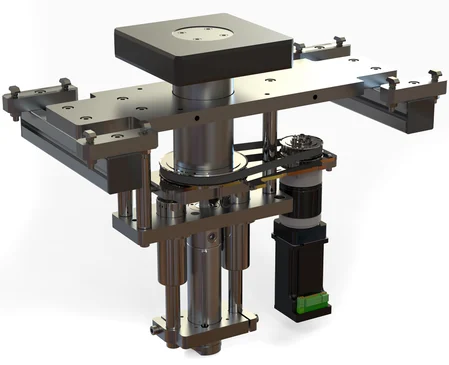
What Is a Lift Transfer Unit (LTU)?
A Lift Transfer Unit, or LTU, temporarily lifts a pallet or product above the conveyor surface and transfers it perpendicular to the primary flow path.
This seemingly simple movement creates significant flexibility within a production line.
Benefits of Lift Transfer Units
- Create alternate product paths
- Support parallel processing
- Add assembly stations
- Improve material flow
- Optimize floor space utilization
- Increase manufacturing flexibility
LTUs are particularly valuable when manufacturers need to expand production capabilities within an existing footprint.
What Is a Lift-and-Rotate Station?
A Lift-and-Rotate Station raises a pallet or product and rotates it to a specified orientation before returning it to the conveyor flow.
These systems are commonly used when products need to be:
- Presented to operators
- Positioned for robotics
- Oriented for vision inspection
- Rotated for assembly processes
- Aligned for testing stations
- Prepared for downstream operations
Automating product orientation can eliminate manual handling and improve process consistency.
What Is a Tandem Conveyor System?
Tandem conveyor systems provide multiple processing paths within a compact layout.
Instead of forcing all products through a single production route, tandem configurations offer additional flexibility and capacity.
Advantages of Tandem Conveyor Systems
- Increased throughput
- Better workload balancing
- Reduced bottlenecks
- Greater manufacturing flexibility
- Support for mixed-model production
- Improved utilization of available floor space
These systems are particularly useful for manufacturers experiencing growth but looking to avoid a complete line replacement.
Signs It May Be Time to Expand Your Existing Conveyor System
Your operation may benefit from conveyor upgrades if:
✅ Operators manually rotate products
✅ Throughput demands have increased
✅ New assembly steps have been added
✅ Vision inspection is now required
✅ Robotic integration is planned
✅ Production bottlenecks are occurring
✅ Additional workstations are needed
✅ Floor space is limited
✅ Products require more routing flexibility
✅ Manual material handling is increasing
These challenges often indicate an opportunity to improve production flow through targeted conveyor enhancements.
Frequently Asked Questions
Can a Lift Transfer Unit Be Added to an Existing Conveyor System?
In many cases, yes.
The feasibility depends on factors such as pallet dimensions, product weight, available space, control requirements, and the existing conveyor layout.
Can Existing Bosch Rexroth, FlexLink, Dorner, or mk Conveyor Systems Be Modified?
Many existing conveyor platforms can be expanded or enhanced with engineered solutions designed to work alongside the current equipment.
An application review is typically required to determine the best approach.
Do I Need to Replace My Conveyor to Add New Functionality?
Not necessarily.
Many manufacturers successfully add transfer units, rotation stations, robotic interfaces, and workstations without replacing their entire conveyor system.
What Information Is Needed to Evaluate a Conveyor Expansion Project?
The following information is typically helpful:
- Conveyor manufacturer
- Conveyor model
- Pallet dimensions
- Product dimensions
- Product weight
- Available floor space
- Desired functionality
- Production rates
- Photos of the application
- Layout drawings, if available
Providing this information early can help speed up the engineering review process.
How Long Does a Conveyor Upgrade Project Take?
Project timelines vary depending on complexity, customization requirements, controls integration, and component availability.
The sooner a project is reviewed, the faster potential solutions can be identified.
Why Manufacturers Choose Glide-Line for Conveyor Expansion Projects
When manufacturers need to add functionality without replacing a working conveyor system, they need a partner who understands how to engineer solutions around real-world production environments.
Glide-Line specializes in creating flexible conveyor solutions that help manufacturers:
- Increase throughput
- Add workstations
- Improve ergonomics
- Integrate robotics
- Enhance material flow
- Reduce bottlenecks
- Extend the life of existing conveyor investments
Whether the goal is a simple lift transfer unit or a complete multi-lane production enhancement, Glide-Line’s engineering team works with customers to identify practical solutions that support both immediate needs and future growth.
Have an Existing Conveyor System That Needs More Capability?
If your current conveyor system needs:
- Lift transfer functionality
- Product rotation
- Additional assembly stations
- Parallel production lanes
- Robotic integration
- Better material flow
You may not need to start over.
Send us:
✔ Photos of your conveyor system
✔ Conveyor manufacturer and model information
✔ Product dimensions and weights
✔ A brief description of the functionality you’d like to add
Our conveyor application engineers can evaluate your application and recommend potential solutions.
Talk to a Glide-Line Conveyor Expert
Get more from the conveyor system you already own and create the flexibility your production line needs for tomorrow’s demands.
Need to Add Functionality to Your Existing Conveyor? Email us your project needs at info@glide-line.com or send us an inquiry today.